I read an interesting post on narcissism and fear of vulnerability yesterday, it also spoke of the role of truth, in finally allowing ourselves to see and know what hurt us in our family of origins and relationships and why. This can be difficult in a family where one is humiliated or shamed for aspects of our expression or self, in a society that makes us feel shame for being human and for making so called ‘mistakes’ which may actually be none other than key or critical learning experiences.
It is recognized that shame and fear of vulnerability and/or humiliation lies at the heart of toxic narcissistic defenses, but the thing about defenses is they are not even fully conscious in the person. My therapist would often remind me that there is a spectrum of narcissism and we are all on it. We need some healthy narcissism to care for and about ourselves but this self care and self championing also needs to be paired with an understanding of those parts of us that may be weaker or less developed and with a concern for our fellow humans as individuals with their own defenses.. Does having these weaknesses or vulnerabilities or defenses make us a bad person? Does the painful living out of dysfunctional attachment styles make us immature or wrong or just developmentally arrested?
One of the key aspects of recovery in 12 step programs is a fearless and searching ‘moral’ inventory.. I do not like that word much but we need to take within the context in which AA was formed, the 1950s, when there was no so much of an understanding of the complexities of both attachment trauma, as well as multi-generational histories.. An early therapist of mine pointed out that one of the founders of AA Bill Wilson suffered for a long time in sobriety with the depression, I wonder if he still, at times, judged himself for the wounds he carried for which he sought the solution of alcoholism. The truth is we are all born soaking in what Anita Moorjani calls a selective collective ‘marinade’ of reaction styles, attachment styles and beliefs that formed us and our families often out of very far ranging and deep experiences across all levels of archetypal human life.
One of the strengths of the program lies in the rigorous honesty and unmasking, in the course of recovery we have to let down the mask and let others in, we need to expose our secret areas of shame, wounding or vulnerability to those who are also healing in order to find approval, acceptance and love. Opening up in this way helps us to grow and also to connect to others, staying marinated in shame only blocks this kind of avenue to us.
In fact an hour ago in the bath I was thinking of how many amazing and awesome words start with the letter ‘A’. Approval, allowing, acceptance, attention, affection . the list goes and it is in places where we can find an abundance of these that we are more likely to open up, share and take the risk to be both vulnerable and honest.
The shame that a toxic narcissist feels is often not conscious. Often it is projected. As in the movie The Wizard of Oz, the person who feels themselves to be small and impoverished inside or did not get to develop aspects of themselves may hide behind a far larger persona, or there is the alternative way of coping that reduces us to the feeling of being lower than pond scum..Its a term my therapist often uses when I treat myself so badly and end up fawning in the face of someone else’s power as she reminds me “Deb, there is actually a lot of life in pond scum!” John Bradshaw, a recovering alcoholic who writes widely on these issues says that before his recovery he either felt more inflated than a God or lower than an earth worm, for him there was no humble realistic middle ground.
Taking the risk to be vulnerable means we can expose tender parts of us but it is not very easy in a shaming society.. One of the books that helped me most in early sobriety was actually by Bradshaw : Healing The Shame That Binds You. Most clearly explained in that book is the toxic shame based aspects of some forms of Christianity and Catholicism as well as other religions, although when I think of Buddhism in some aspects it allows us access to those shadow parts of us rejected by the ‘ego’ that contain a lot of life.. Buddhist teachings say the lotus of our soul and true self in fact requires the ‘mud’ of these things to grow. What is also clearly explained in Bradshaw’s book is how that kind of toxic fear and shame keeps feelings like sadness, and even joy, happiness, d enthusiasm or exuberance bound in shame.. What that means is that, if as a young child, these things met with anger or disapproval in time we cannot feel them without feeling shame,, how sad then not to be able to feel the very things that contain most of our inner power and life.
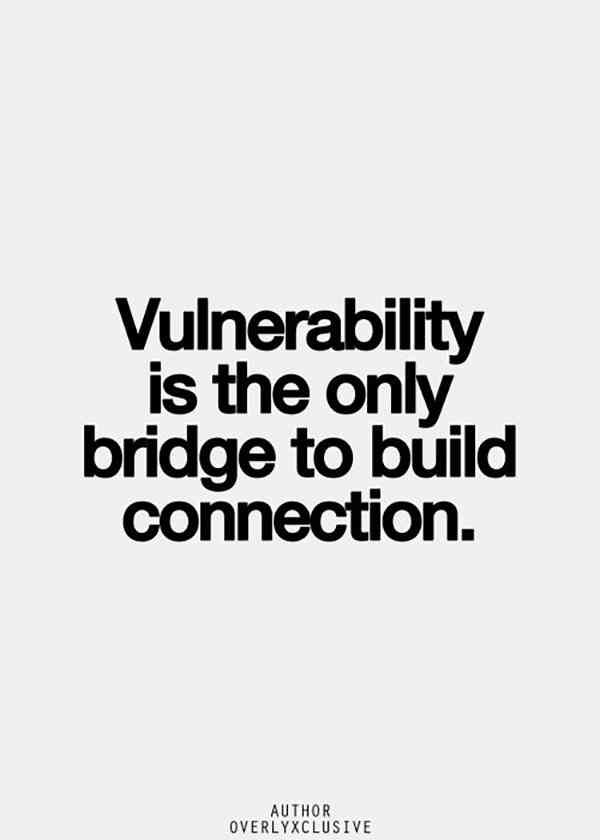
Difficulty containing feelings is also a huge part of addictions, or problems in relationships due to insecure, disorganized or avoidant and anxious attachment styles.. This is where we need the love and wisdom of a good deeply attuned therapist or those in recovery who help us when we are trying to face the triggering of wounds that led us to identify as shame bound or constricted in our feelings and self judgements. It is only when we begin to take the risks of being honest, and vulnerable and opening up to defy the charge of anxiety, fear or shame that these parts can be incorporated and made useful to us.
Sadly in childhood so few of our parents could love us unconditionally, not having known, or been given that kind of love themselves.. When I think lately of what my Mum and Dad and brother and sisters bore I feel far more understanding and compassion.. How could they have given me what they did not have, or how could they understand how it was for me growing up without judging? .. so it is we must look outside of the family and find places to be accepted and known and understood and loved as we are.. Some say that in the end it is only self love and self compassion that will save us, and this is true, but for those of us carrying deep interpersonal relational or attachment trauma who are wounded or damaged in the past by emotional neglect and lack of presence and attunement from parents, we must find someone who can model this for us, because for some breaking the hold of the toxic inner tyrant or persecutor turned inward or outward is just too much work to do all alone..At least this has been my experience.
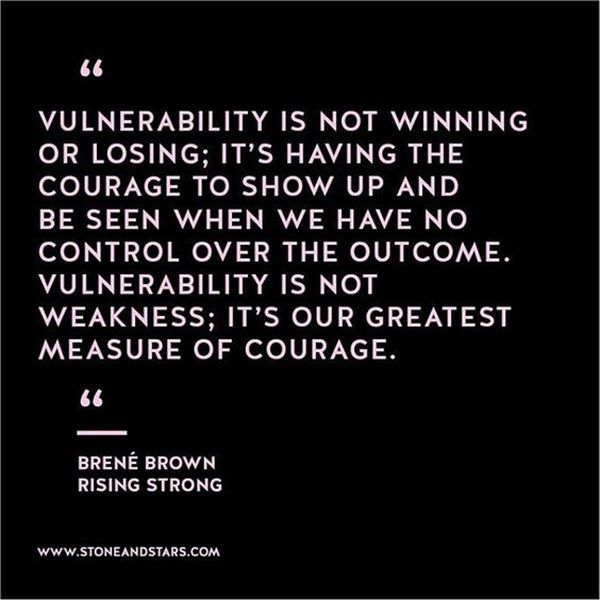
Today I want to encourage honesty, truth and vulnerability. It is not fear we need to fear as much as our defense against feeling and owning our fear of fear. Fear that can be lovingly contained will allow us the courage to act in new ways, to defy old patterns. .. The work of others in recovery such as John Bradshaw, Brene Brown and Glennon Doyle leading the way in this has given and continues to give me hope. Taking the risk to share some of my more painful experiences openly and honestly helps too…. and today I will bask as much as I can in the lived power of all of those ways of being beginning with the letter ‘A’. There is abundance out there for the taking, we just have to open our hearts to it.
 Emerging From The Dark Night