
After being traumatised a child’s relationship with his or her body often becomes formless, chaotic and overwhelming; the child losses a sense of his internal structure and nuance. As the body freezes, the “shocked” mind and brain becomes stifled, disorganised and fragmented, they cannot take in the totality of experience and learn from it. These children who have become “stuck” at some point, along a once meaningful and purposeful course of action, engage in habitually ineffective and often compulsive patterns of behaviour. These often play out in symptoms like those of attention deficit hyperactivity disorder or obsessive compulsive disorder. The child’s uncoordinated fragmented efforts are not registered as normal, explicit, narrative memories but rather are encoded in the body as implicit, procedural memories including discomfort, constriction, distress, awkwardness, rigidity, flaccidity and lack of energy. Such memories are encoded not primarily in the neocortex (upper brain) but, instead, in the limbic system (lower brain) and brain stem. For this reason behaviours and memories cannot be changed by simply changing one’s thoughts. One must also work with sensation and feeling – really with the totality of experience.
Sensations actually become the bedrock for a child’s gradual maturation toward authentic autonomy and independence.
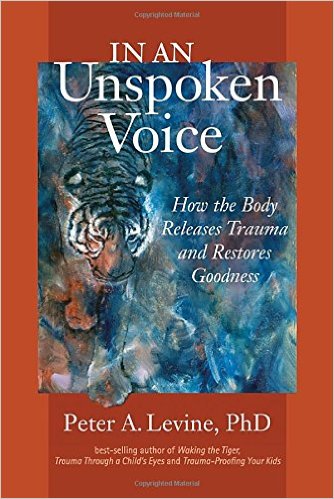
Peter Levine : In An Unspoken Voice : How the Body Releases Trauma and Restores Goodness
 Emerging From The Dark Night
This looks like an amazing resource. I’m going to see if I can find it for download.
LikeLiked by 1 person
Please do. I am going to post a few more excerpts from it. I woke up with page references in my mind today and it is so helpful as a large part of trauma means we are immobilised on a bodily level and getting in touch with why and what we can do to re-engage is so essential for those of us living with PTSD and Complex PTSD.
LikeLiked by 1 person
It’s a fascinating subject because it resonates with me – I know my central nervous system is stuck in a fight-or-flight response. There is a need to break this down and speak into the body parts that are ever “on the ready”that I recognized on my own before even seeing this book reference here. I’ll definitely be looking more into it as I see there are a few authors who write on trauma being stuck in the body.
LikeLike
That is his speciality PG…i will definately post some more…he has an idea about pendulation..moving btwn stuck places and those that are alive and resonate with more pleasant sensation and memory…he hits the mark with his knowledge anf uses many real ecamples of his work with people in that particilar book.
LikeLike